Language Systems
A structured terminology database designed to support translation, LMS content, and AI-assisted production workflows.
AI Workflows
Multilingual Content

About project
This project focused on building an AI-ready terminology system for specialist inland shipping training.
There is a vast array of technical learning content for European learners, including safety training, compliance materials, crew training, certificates, assessments, and LMS course content. Much of the source material is German, while many learner-facing outputs are produced in English for international crews.
The core goal was to create a reliable German-to-English terminology layer that could improve consistency across digital training content. The system also included Dutch and Slovak terminology sections, making it expandable for wider European training needs.
Challenge
Inland shipping uses highly specific technical, operational, and regulatory language. Many terms do not translate neatly into general English, and standard machine translation can produce inconsistent or misleading results.
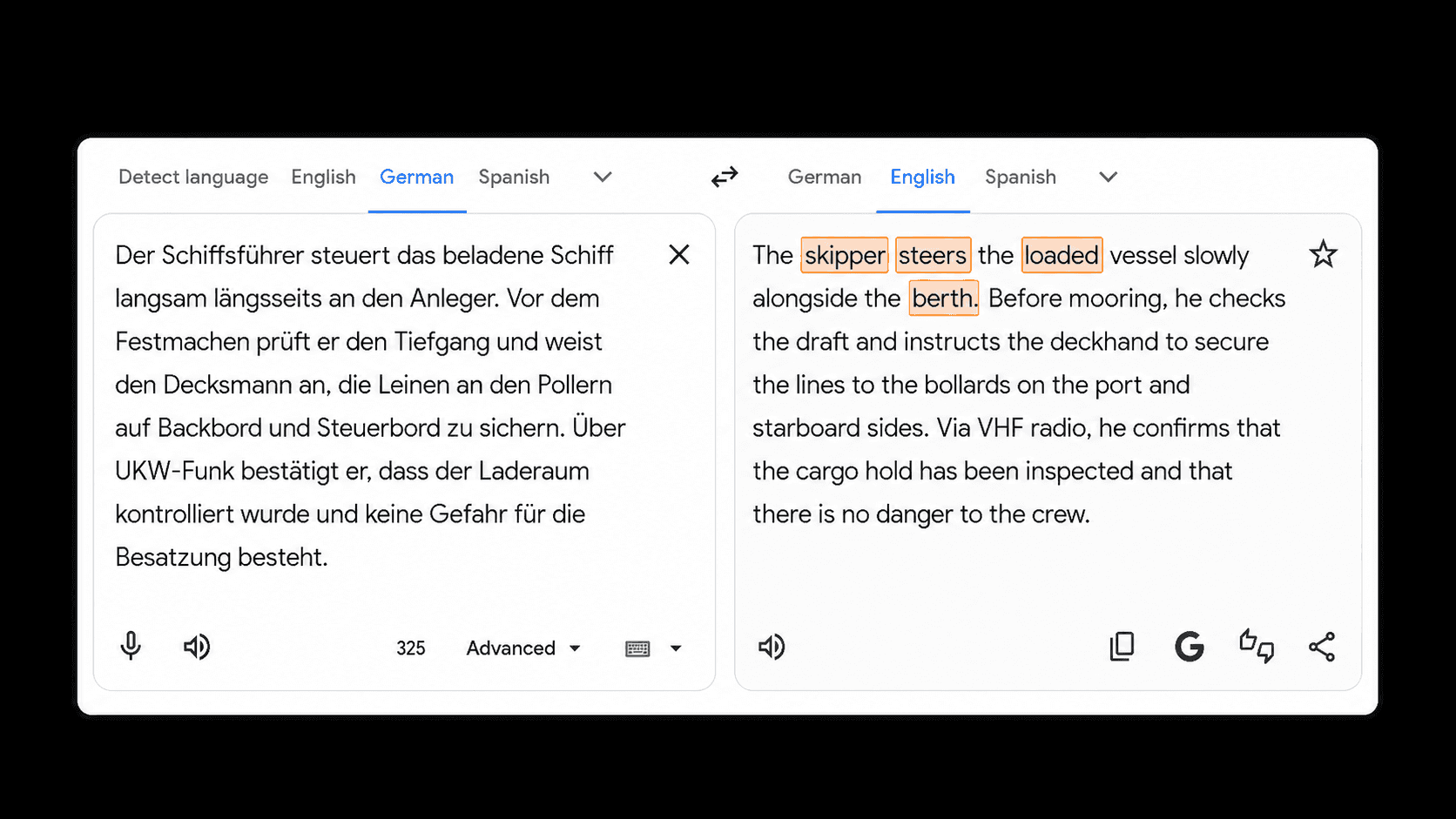
A single German term might appear across course pages, quizzes, certificates, LMS instructions, practical training materials, and assessment documents. If it is translated differently each time, the learner experience becomes inconsistent and the review process becomes inefficient.
For example, the German term “Schiffsführer” could be translated in several different ways:
Captain
Skipper
Ship leader
Ship driver
For inland shipping training, the approved English term is: Boatmaster.
This is beyond just a vocabulary issue. It affects learner understanding, translator consistency, assessment wording, certificate language, LMS content quality, AI-assisted content generation, and SME review.
The challenge was to create a shared terminology system designed specifically for digital inland shipping training.
Process
The terminology database was built primarily around German source terms and approved English equivalents.
Each entry was structured so it could support both technical accuracy and learner-friendly content production. Additional Dutch and Slovak sections were included where relevant, allowing the system to grow beyond a simple bilingual glossary.
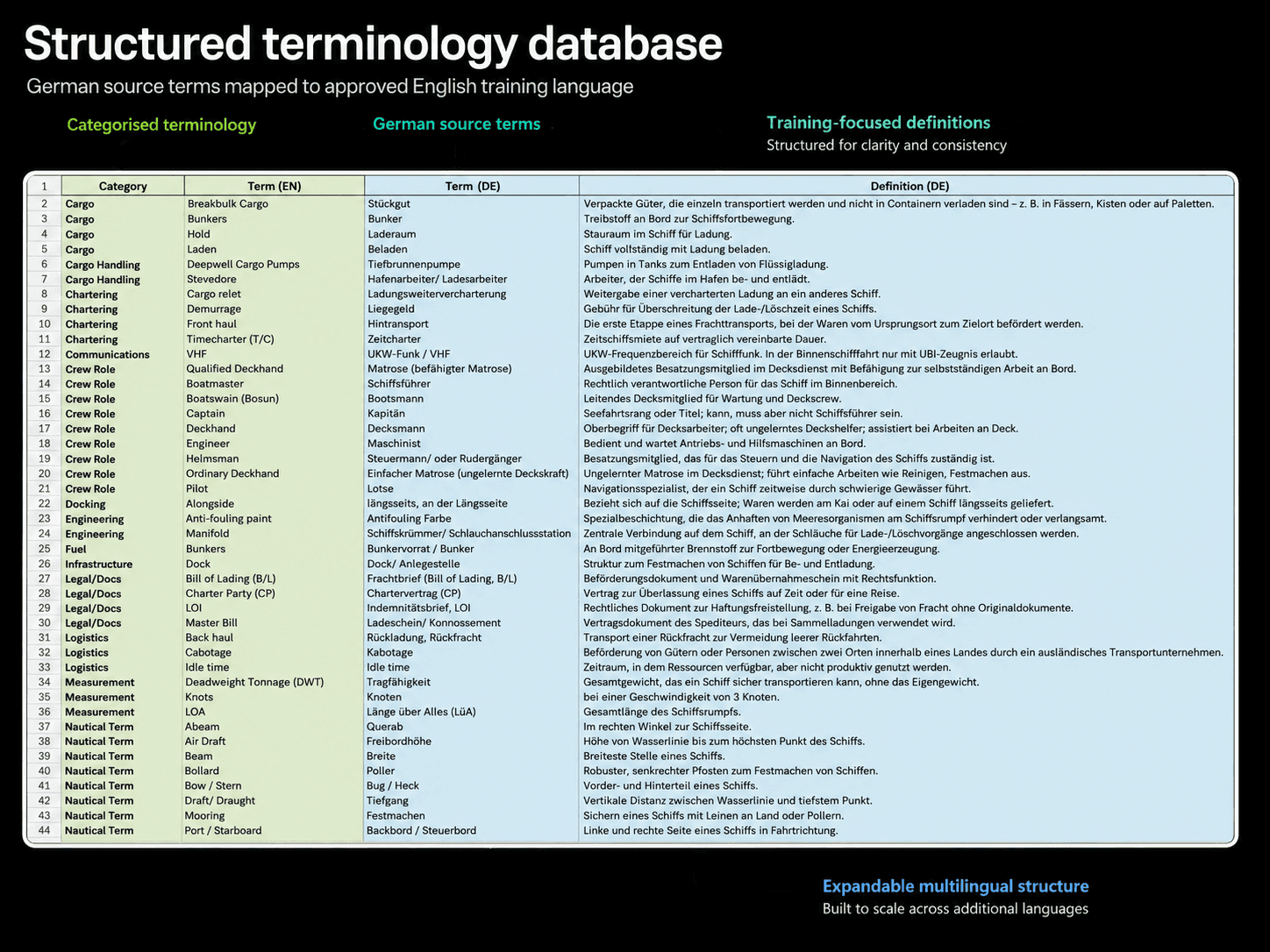
The database structure included:
Category
German source term
Approved English term
Dutch term
Slovak term
Definition
Usage notes
Related training topic
SME comments
Preferred learner-friendly explanation
The system was developed with subject matter input, making sure that terminology choices were linguistically correct as well as being technically and operationally appropriate for inland shipping training.
SME Review and Expandability
The terminology system was designed as a living database, not a fixed glossary.
It can be updated when SMEs, trainers, translators, or course developers identify better wording, missing terms, or new course requirements. This allows the terminology layer to grow with new topics, new regulatory language, new equipment terms, additional languages, translator feedback, and learner support needs.
In specialist training, the “best” translation is not always the most literal translation. The right term depends on how it is used operationally, how learners encounter it, and how assessors expect it to appear in formal training contexts.
SME input made the system more reliable than a generic translation list, as it helped the terminology reflect real inland shipping practice.
AI Workflow Design
Once the terminology layer was structured, it could support AI-assisted production workflows.
Instead of asking AI to simply translate German course material into English, the workflow could be controlled by approved organisational knowledge.
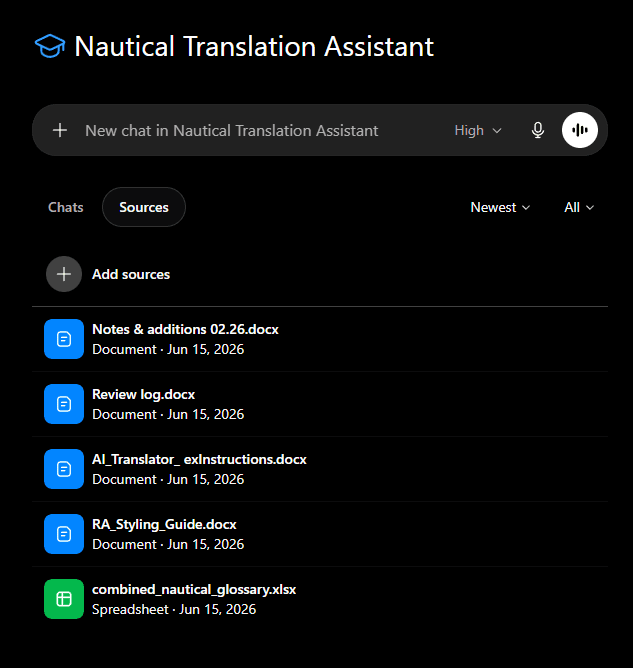
The AI assistant concept used sources such as:
German-to-English inland shipping terminology
Dutch and Slovak terminology sections
Course style guidance
Approved training content
SME-reviewed terminology notes
LMS content rules
The workflow was designed around clear instructions:
Use approved German-to-English terminology
Preserve assessment-critical and regulatory wording
Explain technical terms clearly for non-native speakers
Keep language practical and learner-friendly
Flag uncertain terms instead of inventing translations
Allow terminology updates based on SME review
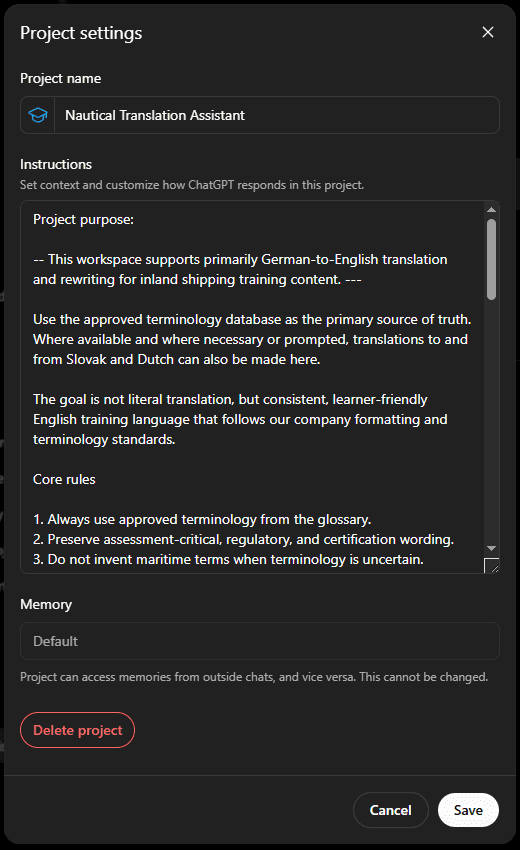
This created a more controlled way to use AI in a specialist training environment.
Workflow Transformation
The main improvement was moving from isolated translation correction to a terminology-first workflow.
Before, the process was correction-heavy:
German source content
Machine translation
Inconsistent English terminology
Manual correction
Repeated fixes across courses
The new workflow started from approved knowledge:
SME-informed terminology database
German-to-English AI / translation workflow
Approved terminology applied
Human and SME review
Reusable multilingual training content
Overall, it made expert review more efficient by giving translators, course developers, and AI tools a stronger starting point.
Output Example
The structured terminology layer can be used to produce clearer and more consistent German-to-English training content.
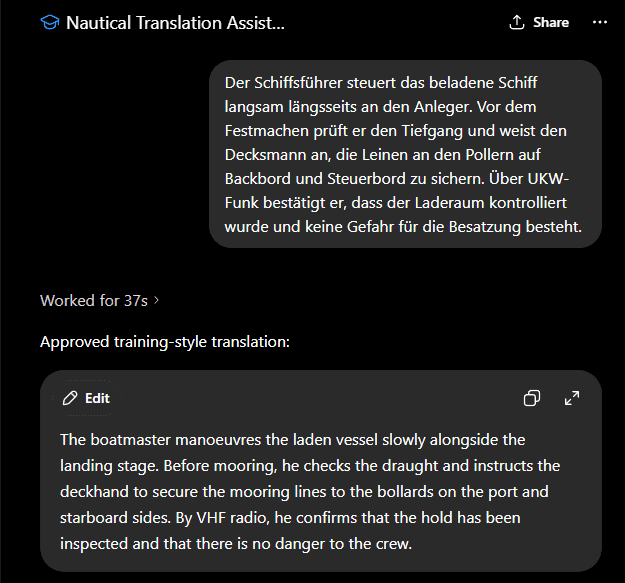
Instead of relying on generic machine translation, the AI workflow uses approved terminology, SME-informed definitions, and training-style language rules to produce English that is suitable for international learners.
For example, controlled maritime terminology such as boatmaster, landing stage, draught, mooring lines, bollards, VHF radio, and hold can be applied consistently across LMS content, course instructions, assessments, and learner support materials.
This supports:
approved German-to-English terminology
reduced manual correction
consistency across courses and assessments
better support for non-native English speakers
faster human and SME review
reusable translation standards
Result
The result was a structured terminology layer that could support translation, LMS content, learner-facing glossary design, quiz creation, certificate wording, and AI-assisted production workflows.
By turning expert terminology into a reusable knowledge system, the project reduced inconsistency, improved review efficiency, and created a foundation for scalable multilingual learning content.
The true value was creating the controlled knowledge layer that allows AI, translators, SMEs, and course developers to work from the same approved terminology.
What this demonstrates
Terminology management
German-to-English content operations
AI workflow design
Knowledge management
SME collaboration
Multilingual training support
Translation quality assurance
LMS content strategy
Learner-friendly technical writing
Human-in-the-loop AI production
Reusable content systems
Project shots